Friday, January 25, 2008

Water Cycle

Much of Antarctica is a polar desert, including the Dry Valleys. This does not mean that there is no water, however. There are many forms of water on Antarctica. There are lakes and streams, glaciers and ice, and snow.

Water on Earth (including Antarctica) is always in movement. It can be liquid (how we usually think of water), but also frozen as ice or as a gas in the air. The sun heats water in the oceans, which causes water to become a gas. This water vapor moves through the air and eventually becomes the clouds high up in the atmosphere. Clouds release the water vapor as precipitation. In most places, precipitation falls and flows along the ground, creating streams and rivers that flow into lakes and the ocean. In the lakes and ocean, the water is then heated again, causing the water to vaporize and return to the clouds. This is the water cycle!
However, in the Dry Valleys and other areas of Antarctica, very little precipitation falls. The only precipitation that does fall is snow, not rain. This means that the ground is very dry, and most of the water in it is frozen. The layer of frozen water in soil is called permafrost. Streams and lakes here on Antarctica are not formed by precipitation, like in most other places. The water cycle is a bit different here.

Since it is so cold here, much of the snow that has fallen throughout history remains today as glaciers and ice sheets. New snow falling compacts previous years of snow until thick glaciers and ice sheets are formed that cover the ground. But, the water cycle does not end on Antarctica. It is just slow, since it is frozen much of the time. Glaciers and ice sheets melt a little bit during the summer. The air needs to only be just a tiny degree above the freezing point, and water will flow from the glaciers. You can see the edge of Canada Glacier melting, where Elizabeth and I were two days ago:
This water flows from the glaciers downhill as streams and creeks. Sometimes there is so much water flowing that it becomes a river! The Onyx River, in Wright Valley, is Antarctica's longest river. We flew over it last week when we were at the Dais.
The streams, creeks, and rivers flow into lakes. Here is a picture of the Lake Fryxell basin from a helicopter. You can see the Commonwealth Glacier, with streams and creeks flowing from it into Lake Fryxell (which is covered with ice). Though these lakes are covered with a thick layer of ice, there is plenty of liquid water beneath the ice. The dark blue edges around the lake is called the "moat" where the ice has melted away, and liquid water is visible.
Unlike lakes in the US, the lakes in the Dry Valleys are closed systems. There are no streams that flow away from the lakes. Water only enters in. So, as the glaciers melt, the lakes become larger. Since temperatures have been rising, glaciers have been melting faster. Lake Bonney in particular has been rising, so that they keep having to move the camp buildings onto higher ground!

Besides glaciers, water is also provided by snow. Much of Antarctica is a Polar Desert, meaning that not much snow falls. In many places on Antarctica, you can find deep snow. But, unlike the US, that snow did not all fall this year. It's a combination of many decades' worth of snow sitting on top of the ice sheets and glaciers. In the Dry Valleys, there is no ice cover, but bare soil. Most snow that falls in the Dry Valleys instantly disappears once it hits the ground, because the soil is so thirsty! However, some snow remains in patches and melt very slowly. These snow patches can provide a source of water for anything living nearby. It's a great place to find mosses growing!

Besides freshwater, there is also salt water around. Taylor Valley ends at the Ross Sea, which opens into the ocean. Most of the Ross Sea is covered in ice. But, like the lakes, there's a ton of liquid water beneath it!
So, as you can see, the water cycle does not stop just because it's cold here. Water is still moving, and the areas with liquid water become very important to the small forms of life that live in the Dry Valleys!

Thursday, January 24, 2008

My Camp Hair

People have been asking why I am not a contestant in the Camp Hair Competition. It's because I just don't have very interesting camp hair. My hair is too long to do anything gravity-defying like our lovely contestants. I would never stand up in a competition against such spectacular camp hair as Mike, Elizabeth, and Nate are sporting.

But, some people have refused to vote until they see my camp hair. So, I took this picture today, at the beginning of day 4 in the field:
See? I told you it wasn't very good.

Keep on voting!

Wednesday, January 23, 2008

Best Camp Hair Competition

While we're out at field camps, we're not able to shower. This means that, after several days in the field, people's hair get really dirty and greasy. This is what we call having "camp hair." Some people take pride in their great camp hair! However, there is some argument about who has the best camp hair in Taylor Valley. So, I'm going to leave it up to everyone reading my blog to decide who has the best camp hair. I'm calling for a vote! Review the photos below of our three "camp hair" contestants, and send in your vote! Anyone reading this is welcome to vote, and can do so by sending an email with your choice to me.

Our contestants are:

Mike:
Festively dressed, Mike is sporting his favorite "spiked" camp hair-do. He masters this look using sweat, sunblock, and anything else that happens to be on his hands when he runs them through his hair. In the field, Mike's hair just defies gravity every single day. In the photo, he has been in the field for 5 days straight.

Elizabeth:
Elizabeth is featuring the "windswept" look. While the front of her hair has been flattened by hours of lying under a hat, don't let that fool you! The back of her head is 4 inches taller than the rest of her! Elizabeth's all-natural camp hair is achieved with no additive ingredients. In the photo, she is on day seven in the field.

Nate:Nate's hairdo is what we call the "twisted" look. Nate's naturally curly hair is enhanced by weeks upon weeks in the field, as Lake Fryxell is his permanent home during the entire field season. Weekly camp showers at Lake Hoare can't keep Nate's hair subdued! See how happy he is to have good camp hair?

So, now you've met your contestants. May the voting begin! Click here to send an email voting for the person you think has the best camp hair. The winner will be announced once the voting dies down. Thanks for playing!

Tuesday, January 22, 2008

How to Sleep like an Antarctican

Elizabeth and I are back in the field now! We're staying on Lake Fryxell again for the next five days. While we're here, we're going to look for more mosses, measure photosynthesis from mosses, and run a test measuring carbon dioxide flux in soils.

So, we'll be sleeping at Lake Fryxell for the next several days, instead of at McMurdo. I should tell you about how we sleep while we're on Antarctica!

While we're in McMurdo, we live in dormitories. There are usually two people to a room, and each person has a bed, closet, and night stand. I share a room with Elizabeth. Here is what our cozy room looks like:

However, many nights we sleep out in the field (like this week!). When in the field, we sleep in tents. There are two types of tents we use here: mountain tents and Scott tents. Mountain tents are the regular dome tents that most people use for camping. Scott tents are the tall yellow pyramid-shaped ones. They are specially designed to be safe during high Antarctic winds. For example, they don't have bottoms, so that if the tent gets ripped up by the wind, the person inside is not blown away, too. During a high wind, such as a katabatic, a mountain tent would be crushed flat, but a Scott tent would not fall over.
Since the ground is loose gravel, it's hard to stake down our tents. We have to tie them to piles of rocks to keep them from being blown away!

It's cold in Antarctica, so we have lots of sleeping gear to help keep us warm when we're sleeping in tents. The picture below shows what I sleep in each night in the field. I have two sleeping pads. One is made of foam, and the other is filled with air (I have to blow it up each time I unpack at camp). I also have a sleeping bag rated for freezing temperatures, a fleece liner inside the bag, and a small pillow. Plus, when it's really cold, I also use my big red parka as an extra blanket!
We work very hard while we're in Antarctica, and don't always get enough sleep each night. So, sometimes we can't wait for our beds or sleeping bags and take naps wherever and whenever we can.

Monday, January 21, 2008

Antarctic Vehicles

There are quite a variety of vehicles around McMurdo that help us get our work done. There are no cars here, only trucks and other utility vehicles. Some vehicles here are similar to those you'd find in the U.S., but bigger and badder! They have to be specially built to handle the weather and terrain of Antarctica. Other vehicles are unique, and you won't find them anywhere else!

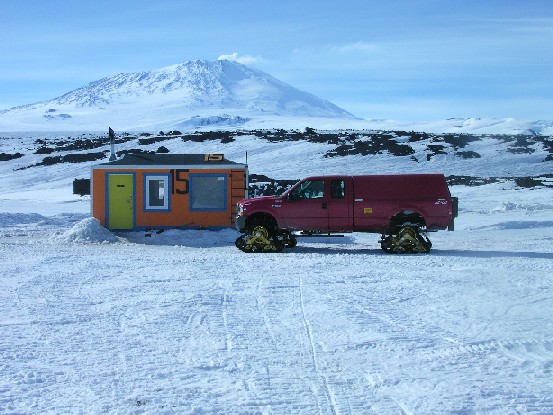
We have a lot of pick-up trucks here for carrying cargo and supplies between buildings. Our pick-up trucks have bigger wheels, and the bodies are jacked up off the wheels. Larger wheels have more surface area in contact with the ground than smaller wheels. That means that the weight of the truck and the cargo are spread over a greater area, lessening the chance of sliding on the ice or loose gravel. All of the trucks are 4-wheel drive, and have special brakes that keep them from sliding when parked.

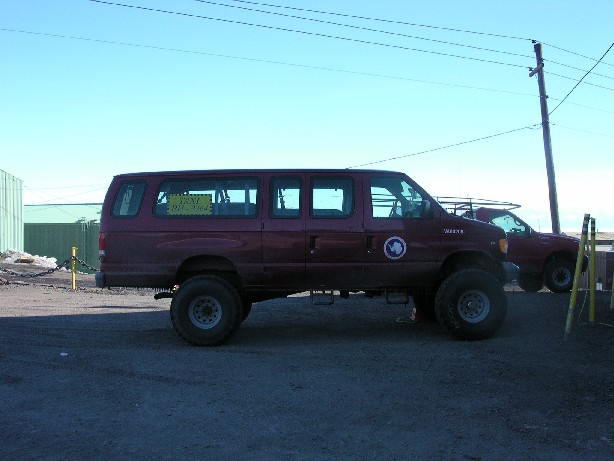
We also have taxis here at McMurdo for carrying people around town or between stations. These are not the yellow taxis like you'd find in the U.S., but 4x4 vans with big wheels!

Sometimes the trucks have special track wheels put on (like what bulldozers have, but smaller). These trucks are called mat tracks, and are used to drive over the transition onto the sea ice. The track wheels can span crevices in the ice and keep good traction with the ground, so are safer than normal wheels for traveling on ice.

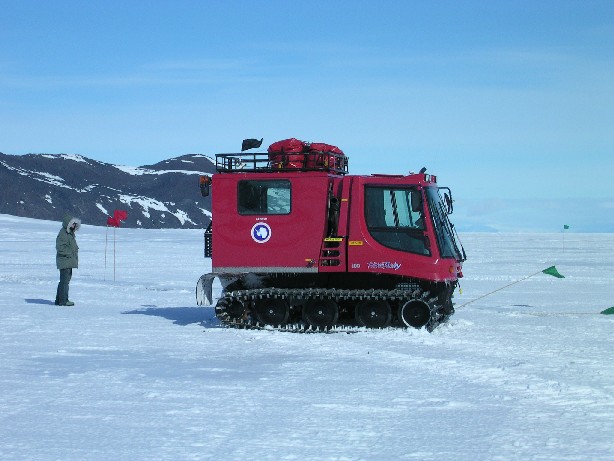
My favorite Antarctic vehicle is the piston bully. Piston bullies are used like pick-up trucks, but have a long track that allows them to drive in deep snow.

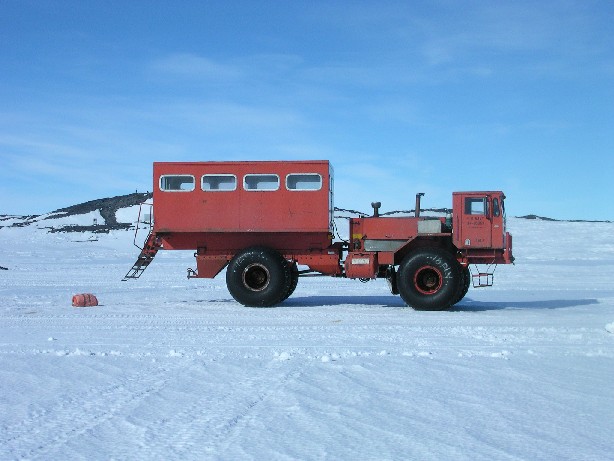
There are also other types of transport trucks that are special to McMurdo. Delta's are used to transport people on the ice roads out of McMurdo. You can take the Delta to get to the air fields, the New Zealand research base nearby, field camps on the ice, and other places on the sea ice. The tires are HUGE (taller than a second grader!). When you ride in the back of a Delta, you have to wear a seat belt. They're so tall that they rock very far when going over large bumps and cracks. If you're not wearing a seatbelt, you slide right out of your seat!
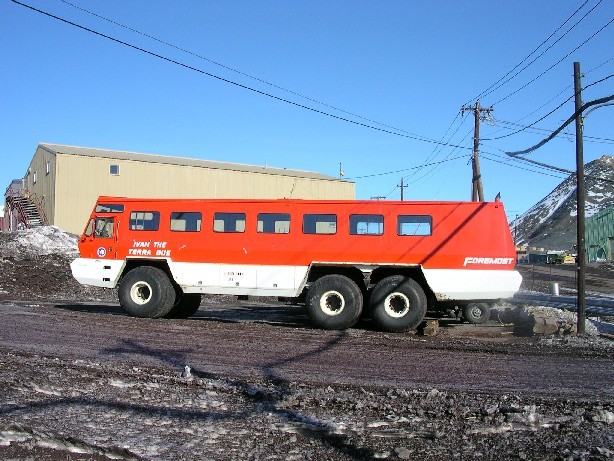
One of my favorite special transport vehicles is the terrabus. This bus carries people to and from the landing strip at Pegasus air field (which is where the plane lands to take us to and from New Zealand). Its name is Ivan the Terrabus. He moves very slooooooowly, but can carry a lot of people across the sea ice.
And, of course, there's my absolute favorite way to commute to work in the morning: helicopter! We have two types of helicopters here. Bell 212's are bigger helo's that can carry up to 8 people and a lot of cargo. A-Star's are smaller. They only carry a couple of people and not as much weight as a 212. But, I prefer A-Stars, because you can sit up front with the pilot!


Tomorrow morning, Elizabeth and I head back into the field to stay for 5 days at Lake Fryxell. We will use a variety of these vehicles to get us there!

[Photo credit: truck photos from 77DegreesSouth and B-518-M.]

Saturday, January 19, 2008

Day Tripping

This week we've been taking a lot of day trips into the field. Rather than spending several days or a week out in the field, we fly out in the morning, spend all day collecting samples, and return to McMurdo in the evening.

Elizabeth and I have gone back to both Lake Fryxell and Lake Bonney on day trips to measure soil respiration. Two weeks ago, water and nutrients were added plots of soil by both lakes. Elizabeth and I went to the plots to learn how much the soil animals were breathing after the additions. We want to know which nutrients make the soil animals breath the most. We took our measurements, and now we have to look at all of the data to answer the question!

We've mostly been working in Taylor Valley. But, there are other valleys in the area that are part of the Dry Valleys. Each valley in the area was formed by different glaciers at different times in history, so the soils in each valley are different. We want to learn more about the other valleys, not just Taylor Valley! So, we took a trip to Wright Valley, which is slightly farther north. It was fun to fly there, because I got to see new parts of the Dry Valleys from the helicopter!We visited two places in Wright Valley. First went to the Dais, which is a flat, elevated area with very interesting soils. The carbon in the soil (which soil animals eat to get their energy) is very different from other soils we've looked at. This is why we wanted to go back and look some more! We took soil samples from many different places around the Dais, and we've brought it back to the lab. We will analyze the soil to learn more about the carbon and other nutrients from all over the Dais. Here is a picture of the four of us after our sampling at the Dais:


Here is a video I took from the helicopter leaving the Dais. You can see how flat the top of the Dais is, and how it drops off very steeply to the valley below.


Next, we went to the other end of Wright Valley to Lake Brownsworth. We were looking for mosses. While there are many places in Taylor Valley to find mosses, there aren't many in Wright Valley. We looked extra-hard along Lake Brownsworth, but didn't find any! We wonder what makes Wright Valley so different from Taylor Valley that keeps mosses from growing there. So we took some soil samples, and hopefully we will find out!

We want to look at other Dry Valleys, besides Wright and Taylor Valleys. Tomorrow Elizabeth and I are going to Garwood Valley and Marshall Valley, which are farther south. We will sample soil and try to find mosses there, too.

Thursday, January 17, 2008

Who Owns Antarctica?

During the late 1800's and early 1900's, many countries sent explorers to Antarctica to claim pieces of the continent for their home countries. By 1950, there were 12 countries that were actively exploring or working on Antarctica. They were: Argentina, Australia, Belgium, Chile, France, Japan, New Zealand, Norway, South Africa, the USSR, the United Kingdom, and the United States. Most of these countries had staked claims on portions of Antarctica, many of which overlapped with one another. Many countries already had research stations in various parts of Antarctica, often in other countries' territorial claims.

Since Antarctica is such a unique continent, with such a great potential for learning and research, there was a mutual desire among these countries to maintain Antarctica as a peaceful continent. They wanted to make sure that "in the interests of all mankind that Antarctica shall continue forever to be used exclusively for peaceful purposes and shall not become the scene or object of international discord."

In 1959, these twelve countries met to create the Antarctic Treaty. Under the Antarctic Treaty the countries agreed to cooperate and promote scientific investigation. All territorial claims were suspended. Antarctica has no permanent populations or citizens, only research bases like McMurdo. The countries agreed to have free exchange of information among each country's research groups. No military action is allowed on Antarctica, and weapons may not be kept here. The military may only provide science support on Antarctica. For example, the Air Force flies scientists to McMurdo station, and the Navy helps with shipment of supplies. There are also environmental laws, that preserve the conservation of the animals, plants, and ecosystems of Antarctica. These laws are why we need to be so careful about the water we use, where we leave our footprints, and how we interact with wildlife. Mining and nuclear explosions are banned.

Each country is responsible for making sure its citizens on Antarctica obey the Antarctic Treaty. The U.S. keeps a U.S. Marshall on base to prevent any law-breaking on American bases. However, he is not allowed to carry a weapon.

Since the Antarctic Treaty was signed in 1961, a total of 46 countries have signed it. Many different countries have research stations in different areas of Antarctica. The U.S. has three bases: McMurdo, South Pole, and Palmer (which is on the Peninsula near South America). The map below shows the research bases on Antarctica and which country supports them.
The territorial claims made before the treaty are still recorded, though they are suspended. Seven countries have territorial claims. These claims are pie-wedges of Antarctica that start at the South Pole and extend outward. McMurdo is on New Zealand's suspended territorial claim.

The flags from the original 12 countries are still displayed here at McMurdo.