Friday, March 11, 2022

Research wrap-up

We spent our last week finishing our research projects. One of the final projects we've been working on is Dr. Angelica's climate warming experiment. 

We still don't know all of the impacts of a warming climate, especially in a place so sensitive as Antarctica. In the U.S., being just a few degrees warmer isn't so noticeable to most of us. But in Antarctica where temperatures are so close to freezing, a few degrees is the difference between frozen water and liquid water. That matters a lot for the plants and animals that live there! The Antarctica Peninsula has already warmed by a few degrees over the recent decades, and will likely continue warming with the rest of the planet. Dr. Angelica has been learning the consequences of those warmer temperatures for the soil and plant communities.

How can we try to predict what will happen to the soil and moss that live in Antarctica when it's a few degrees warmer than it is now? We use structures called "open top chambers".  These are little greenhouses that are placed over the ground. The tops are open, so that rain and snow can still come in, but the sides help warm the soil and air inside the chamber by a few degrees. Dr. Angelica has placed some of these chambers at a few different sites around King George Island. We were most recently working on ones on a bluff that overlooks the Drake Passage.

The open-top chambers at Juan Carlos Point.

Inside the chambers, the soil and air are a few degrees warmer. So the moss and soil inside the chambers are experiencing a future Antarctica where it is a few degrees warmer. By watching how the soil and moss changes, we can try to predict the effects of climate change. Dr. Angelica studies how the plant community changes, and we will be looking at how the invertebrate community living inside the moss changes. We also measured photosynthesis and respiration inside the chambers. All of this will be compared to what's happening outside the chambers in "normal" Antarctica.

A peek inside an open-top chamber at Collins Outcrop, one of the other locations for the experiment.

So we've been working hard to finish collecting all of our samples. It's been very busy! There is of course time to stop for a little fun here and there, though. I brought my ukulele with me, and took a break to serenade the glacier. (My fingers were VERY cold, so don't listen too carefully for the mistakes.) Young people out there might not recognize the song. It's the theme from a muppet show called Fraggle Rock. If you've never heard of it, maybe ask your parents. :)


Tuesday, March 8, 2022

Photosynthesis & respiration

We have been busy working on our research projects. We completed our transplant experiment, which we like to call our little garden. We have planted grass, two different species of moss, and a cyanobacteria. In the coming years, we will check their progress and measure how the soil beneath them is changing.

Recently, we have been busy measuring photosynthesis and respiration from plants and soil. This is how we can describe how “busy” they are. When plants photosynthesize, they take up CO
2 from the atmosphere and lock it away inside the plant. Respiration is the opposite process, where the carbon inside of organisms is released back to the atmosphere as CO2. (Even humans release CO2 when we respire. When we breathe, we take in oxygen and release CO2.) To measure how active our plants and soil are, we measure how much CO2 is taken up by photosynthesis and how much is released by respiration. This is how we can measure the amount of carbon moving into and out of the soil ecosystem. We want to know which plants photosynthesize the most. We also want to learn whether the microorganisms living in the soil respire more when they live under certain plants.

To do this, we use an infrared gas analyzer. That’s a fancy name for a machine that uses infrared light to measure the concentration of CO2. We place the chamber on top of the plants and soil to trap the atmosphere inside. If the plants are photosynthesizing, the CO2 in the chamber will start to decrease, because plants take up CO2. If we use a dark chamber like in the photo below, photosynthesis will stop. But if the plants and microbes are respiring, the CO2 inside the chamber will increase, because we all exhale CO2 when we breathe.

We have measured plant photosynthesis and soil respiration from all of our study plants in all of the stages of succession. So we have done a lot of hiking to all of our sites where we find the different stages of succession. We get very tired, but we have a lot of data now!

Thursday, March 3, 2022

Mesozoic Antarctica

Antarctica hasn't always been the cold, icy continent that it is now. In the Mesozoic Era, 60-250 million years ago, Antarctica was lush and green. The Mesozoic (meh-su-ZO-ick) Era is the period of Earth's history when dinosaurs ruled the Earth. (The Mesozoic Era is divided into three periods: the Triassic, Jurassic, and Cretaceous. Those are probably names you're more familiar with.)

During the Mesozoic, the entire plant was warmer, so the poles were not as cold as they are now. There were vast forests of conifer trees and huge ferns growing in Antarctica! Why was the Earth so warm back then? Geologists have learned that there was rapid sea floor spreading. Magma was quickly venting to the surface, and along with it came a lot of CO2 (a greenhouse gas) into the atmosphere, making it a very warm planet.

The warmer temperatures meant life could spread across the continent. It wasn't such a harsh habitat back then! We know there were plants growing at that time because we find fossilized pollen spores, pieces of wood, and even whole plant leaves. Imprint of the leaves can be found in sandstones and mudstones, creating pictures of the leaves that last for millions of years. 

Fossil print of a fern near my foot.

These plants provided food for many other organisms that lived in Antarctica at the time. There were insects, arachnids, and even dinosaurs, birds, and marsupials in Antarctica! Their fossils are commonly found at the northern end of the Antarctic Peninsula.

I do not work in the parts of Antarctica where dinosaur fossils are common, but I have come across the fossils of marine organisms that date back to this time period as well. The Antarctic Peninsula has a lot of fossilized prehistoric mollusks, including cephalopods (modern day members are squids and octopi) and bivalves (like clams).

Belemnite fossils in rock from Alexander Island.

Fossilized imprint of a bivalve. (Sorry, it's a little blurry!)

Antarctica was ice-free like this until about 35 million years ago. The Earth cooled and the Antarctic continent shifted further south, making it the polar ecosystem that we know today. Most people don't know that it was once very lush and green. It's fun finding traces of that history when we are bundled up against the cold in the field! 


Monday, February 28, 2022

A history of exploration

For a long time, Antarctica was an unknown continent. In the 1400's and 1500's, Antarctica was just a hypothesis. So, at the time that Leonardo da Vinci and William Shakespeare were alive, nobody had seen Antarctica, but they thought it probably existed. It was referred to as Terra Australis Incognita (unknown southern land). Maps from the time show a rough outline of where they thought Antarctica was.
Photo credit: Wikimedia

People began taking ships further and further south to find this new continent. They encountered islands along the way, which they sometimes thought were attached to that southern continent. (They were wrong!) Some of the maps from that time are very funny!
Compare this map of Antarctica from 1616 (from the Princeton library) to the real one below. They didn't quite get it right!


The first historical record of humans seeing Antarctica in person is from the 1820's. (I say 'historical record' because it's quite possible that Polynesians from the South Pacific had discovered Antarctica well before the rest of the world, but it's hard to find written record of it.) These first sightings were from ships traveling to the coast of Antarctica. Humans didn't start walking around on land until the early 1900's. These explorers were like the astronauts of their time! They were traveling into a completely unknown land, far from the rest of civilization, and the only resources they had in these extreme conditions were what they packed with them. The idea of spending a year in Antarctica was similar to the way we think about spending a year on the International Space Station today. They faced dangerous conditions, and if they returned from their expedition alive, they were famous!

Much of the early human activity on the Antarctic Peninsula wasn't for science or prestige, though. Some of the first human inhabitants on the islands near Antarctica were sealers and whalers. (Those are people who hunt seals and whales for their fur, meat, and blubber.) A lot of whales and seals migrate to the ocean around Antarctica during the summer, because there are a lot of krill and phytoplankton to eat. That meant the hunters could make a lot of profit! King George Island, where we are working, was the base for a lot of seal hunting in the early 1800's and by the end of that century, the fur seals were almost entirely gone.  
Fur seals have returned to the region, after being over-hunted in the 1800's.

Then the whalers moved in during the early 1900's. Whaling was so busy that almost all of the world's whale species were hunted close to extinction! Less profits meant that a lot of the whalers left, and then of course it is now illegal to hunt whales or seals in Antarctica for profit. 

The whalers and sealers were the only inhabitants of King George Island until the 1940's when scientists arrived. Many of the places that were once whaling camps are now scientific research bases used by many different countries. In fact, whale bones are still lying around King George Island near the bases.
The spine and rib cage from a whale near Arktowski Station on King George Island.

Ecological succession even happens on skeletons! Moss growing and soil developing in a whale vertebra at Admiralty Bay on King George Island.

Today, only research bases remain on King George Island, and there are many from nations all over the world. It is only a place of scientific exploration and cooperation, not hunting! The bones remain as a reminder of the damage humans have caused in the past.

Want to know more about the history of King George Island, specifically? This article gives a nice summary!

Friday, February 25, 2022

Antarctic gardening

We have been busy working in the field to set up our main experiment. This is an important way that we can study the plant-soil feedbacks during succession. How do you know for sure that adding a plant changes the soil? You add a plant to bare soil, and see how the soil changes! So, we are starting a "transplant" experiment. 

We are taking grass, moss, and algae from the surrounding area and planting them into bare soil in an early succession zone. (So, we are "transplanting" the plants from one area to another.) We sampled the bare soil before adding plants, so that we can understand the early succession soil before plants colonize.

Here I am, sampling the bare soil in one of our soon-to-be transplant plots.

We will measure the bacteria, fungi, and invertebrates in the bare soil. We will also measure the amount of nutrients and other chemical properties that are important for sustaining life. That will give us a picture of the soil before plants arrive.

Then, we did a little gardening! A couple days ago, we moved tufts of the Antarctic hairgrass into our bare soils. 

Dr. Hannah is happy to plant her grass.

Today we moved two different species of moss. Not all moss are the same! Some mosses are pleurocarps, like Sanionia on the left side of the photo. They spread out on the surface of the soil, growing overtop of what's below them. They make a mat that you can peel up from the ground, almost like a carpet. (They can also regenerate from pieces of the mat that have blown in the wind, and survive on top of rocks, making them good pioneers in early succession!) Other species, like Polytrichastrum on the right side of the photo, are acrocarps. They grow into the soil. Their rhizoids (the root-like part of the plant) intertwine into the soil like turf. Those we have to move in tufts like grass.

Sanionia (the pleurocarp) is being laid down on the left. Grass is in the middle, and Polytrichastrum (the acrocarp) is on the right.

We have one more plant left to move, which is the algae. We will hopefully be able to finish that tomorrow, and our experiment will be set up!

As the plants grow, they will begin changing the soil. They will perhaps add nutrients, create a habitat for more soil organisms, and change the temperature and moisture of the soil. We will revisit these transplants for three years to measure how the plants change the soil as they grow. By making the same measurements as we make on the bare soil at the start of the experiment, we will see how the plants change the soil chemistry and biological community.

It feels good to have our main experiment almost completely set up!


Wednesday, February 23, 2022

Birds on the Antarctic Peninsula

Because I study soil, I talk a lot about the microscopic organisms that live in soil. But there are, of course, other, big animals that spend part of their year in Antarctica. Some people find these animals interesting, so I'll tell you about some of them. (But how could they be MORE interesting than springtails and midges?!?!) 

The coolest diversity of animals that live on the Antarctic Peninsula are the birds, so I'll start by talking about those. There are actually quite a lot of birds that spend their summers in Antarctica! Here are a few that I think are the most interesting.

One of my favorite species is the giant petrel. I like them because they are so big! Their wing span is 6-7 ft. Their length wingtip-to-wingtip is bigger than many humans are tall! They are seabirds who eat fish, squid, penguin chicks or other birds... and generally anything they can fish out of the ocean.

My pictures of adult giant petrels aren't very good, but you can see lots of other pictures at eBird.

A baby giant petrel, in a much better photo taken by Terri Nelson.

Everyone's least favorite bird is the skua. Skuas are very aggressive. They are scavengers who eat whatever they can find, sometimes by stealing that food from others. They will dive at other birds carrying food to startle them into dropping it. They'll even do it to humans if you're outside carrying a sandwich! They are also very curious and will steal shiny objects, so they have been known to pull off metal tags, steal flagging that marks your research sites, and even steal your computer cables! They can be very pesky when you're trying to do science.

A skua stalking around our field camp, looking for food to steal. You can see more pictures at eBird.
Skuas are much less mean when they are this size!
Skuas are also very good parents. They will attack anyone who tries to come near their nests! They nest on the ground and the eggs and chicks are very well camouflaged, so you might not even know you're near one. But you'll know when a skua dives at your head with its very sharp beak! They don't want anybody getting near their babies.

Another interesting bird is the snowy sheathbill. They are kind of ugly, because they don't have feathers on their face. Like vultures, they eat carrion (dead animals), feces, and other things they can scavenge. That means they have to put their faces in some pretty gross places! You probably haven't heard of a sheathbill before, because there are only two species of them, and they both live around Antarctica or the islands just to the north.

Snowy sheathbills photographed by Terri Nelson. You can see her scientific illustrations of sheathbills and other birds here. You can also see other pictures of them at eBird.

Of course the most famous Antarctic birds are penguins. Let's not forget that these are birds, just birds that can't fly! Their body shape makes them good at swimming, but very goofy on land. There are three species that live on the Peninsula where we work: chinstrap, gentoo, and Adélie penguins. Penguins are the most stinky of the Antarctic birds. They eat krill, which makes their poop smell very "fishy". They poop all around their nests, so rookeries are covered in poop (called guano), and boy does it smell bad!

Chinstrap penguins have that name for an obvious reason!

Gentoo penguins have the white splotch on their head.

Adélie penguins have the white ring around their eye.

So there is your introduction to a few of the birds that live on the Antarctic Peninsula. They live alongside other marine animals like seals and whales, but we will talk about those another time.


Sunday, February 20, 2022

Invasive species in Antarctica

Antarctica is a harsh continent, so only specialized organisms survive here. These are species that evolved to withstand the freezing temperatures, periods of darkness, and lack of water (and in some places, lack of food!).

Because of the warming climate, though, organisms from other continents can survive in Antarctica now. If those foreign species arrive in Antarctica, they might not die in the harsh habitat like they would have a few decades ago. The Antarctic Peninsula has a growing problem with invasive species. 

One invasive species in Antarctica is a grass. I've told you about the one native species of grass, the Antarctic hairgrass (Deschampsia antarctica). In Antarctica, it can only survive on the northern end of the Antarctic Peninsula. There is also an invasive grass that has been able to move into some areas. That grass is Poa annua, also called bluegrass or meadow grass. It is a species of grass that grows in a lot of places over Europe, Asia, and North and South America, but was not able to survive in Antarctica. But now it can, and it has established itself on King George Island where we are working. This is a problem, because it is a grass that is very good at outcompeting other grasses, so can take over an ecosystem. That is especially possible if the climate continues warming in Antarctica! How did it get there? People visiting Antarctica, carrying seeds in their boots or gear without realizing it.

Poa annua reported by Znoj et al. in this paper.

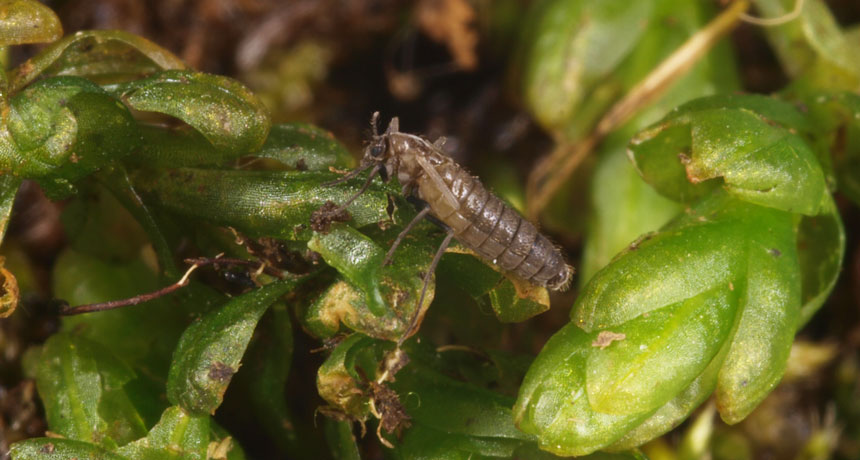
There is also an invasive species of midge that has moved in on the Peninsula. There is a native midge I've already told you about (Belgica antarctica), but there are also distant relatives of that midge that now live in Antarctica (Eretmoptera murphyi). How did they get here? They were brought in by accident in some potted plants that were being moved to Antarctica from other islands north of Antarctica for a scientific experiment. (That is why there are such careful restrictions about transporting soil and plants now!) This new midge is unlike any other organism that lives on Antarctica: it eats dead plant material. The islands along the Antarctic Peninsula are covered in a lot of dead plant material from old moss and grass. (Because nobody lives forever, but its decomposition is naturally very slow so it builds up over the years.) So, the invasive midges have a lot of food, but no predators living there, so they can grow and reproduce a lot! They can eat a lot of the dead plants, recycling the nutrients and creating soil much faster than would happen naturally. It is a level of consumption that does not naturally exist in this area! They create so much change that they can be considered an "ecosystem engineer". 

You can read an article about this pesky alien midge here.

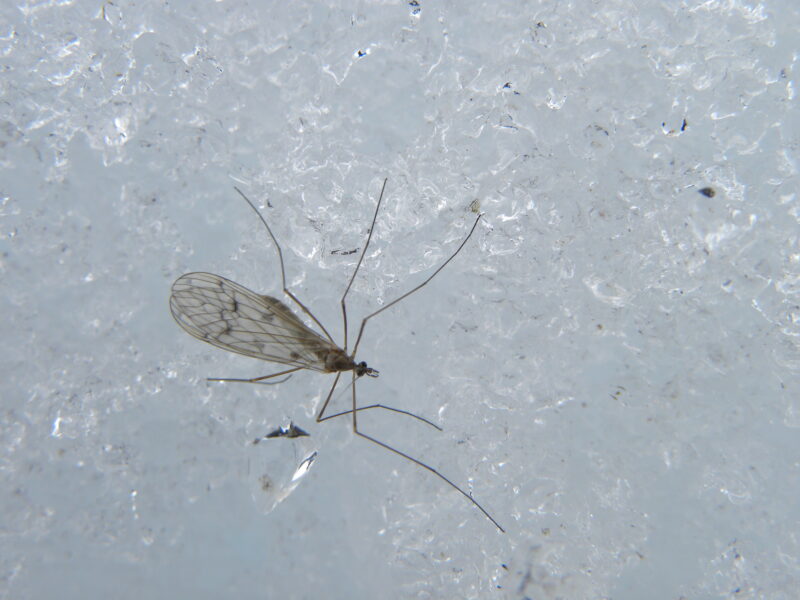
The midge isn't the only invasive insect in Antarctica. On King George Island, where our work is based, there is another invasive insect called Trichocera maculipennis. This is a crane fly that is native to the northern hemisphere, mostly in Europe, so it moved a long way! They survive around sewage systems of the research bases on the island. This species of fly can actually fly! They can survive out in the natural environment away from the sewage, which is how they can move from station to station. This species exists here at Escudero station, and one has already flown into one of our samples!

You can read about this species and other invasive species with the British Antarctic Survey.

These species were all accidentally introduced by people, because their larvae and seeds are so small that people didn't notice them on the products they were bringing into Antarctica. We are much more aware of it now, and we are now required to sterilize our boots in between each place we visit in Antarctica so that we do not keep moving them into new places. We have to avoid future damage from bringing in new species that might tip the natural balance in Antarctica!