Friday, January 6, 2023

A quick update from the Betanzos

We successfully made it to Antarctica! Our flight left Punta Arenas, and we landed on King George Island the night of January 2.


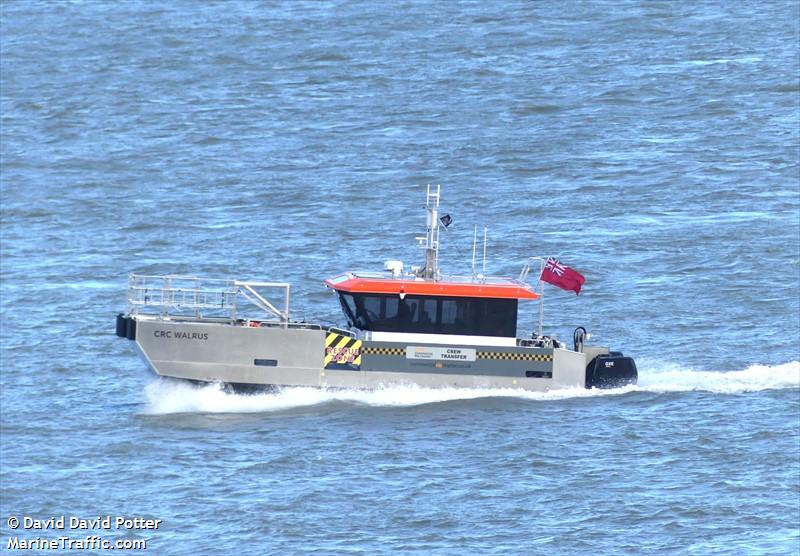
We briefly visited Base Escudero, where we stayed last year. From there, we took small boats out to our research vessel: the Betanzos. It was very late at night (about 1 am on Jan 3), so it was almost like dusk. The lights on the horizon at the upper left are from the Betanzos. Our home away from home!


After dropping some scientists off at Base O’Higgins, we have been moving along the northwest side of the Antarctic Peninsula. We stop at a new site each day, and the ship sails to the next at night. So far, we have collected samples at Isla Duroch where there are a lot of chinstrap penguins. 


Now we have moved on to Baya Esperanza (Hope Bay) on the tip of the Peninsula. There is an Argentinian base with a cell phone tower. That is why I have a little bit of internet… for right now! Tonight we will move on to the next site, away from cell reception. 


At each site on our “cruise”, we are looking for the succession gradients from a receding glacier where plants are beginning to grow. We are hopeful that Baya Esperanza will have the sites we need! However, we have been on a weather delay all day. It is not safe whether to take the Zodiacs (the small boats) from the Betanzos to the shore. 

So we are just waiting for conditions to improve… hopefully tonight!


Monday, January 2, 2023

A brief stop in Punta Arenas

We safely arrived in Punta Arenas, Chile. Normally we stay here for a couple of days to pack gear and get ready. But, bad weather is moving into the area where we will land in Antarctica, so we can’t wait for tomorrow. We have to leave tonight! That means we had two hours to do all of the things we would normally do over a couple of days!

We quickly went to our hotel… not to stay overnight but to get a fast shower and brush our teeth. (We have been in airports and airplanes for a day and a half. Yuck!) We received our cold-weather clothing from the Chilean Antarctic Institute, and repacked our luggage to be ready for use in Antarctica. We also got the safety gear we use from the U.S. Antarctic Program. It has been a busy couple of hours! We ate a quick dinner at the hotel, too, because it’s the last food we will see until tomorrow morning!

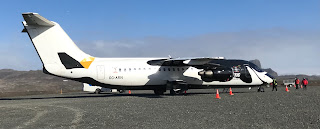
Now we are back at the airport waiting for our flight to Antarctica. There is our fight at the top of the Departures board!


We will fly for about two hours to King George Island (which in Spanish is Isla Rey Jorge). This is where the Chilean Base, Escudero, is. However we are not staying at Escudero. We will board a ship to visit the sites in the map I showed you a couple days ago. 

Hannah and Becky about to board the plane to Antarctica

We will have no internet on the ship, so there won’t be any more blog posts until mid-January when we’re back at Escudero. I will tell you all about our adventures when we are back in contact!

…And we’re off!


Dr. Becky and Dr. Hannah are on their way to Antarctica! We are currently flying from our homes in the U.S. to Punta Arenas, Chile. Here we are in the Santiago airport. We have made it to Chile! Now we are waiting for our flight to Punta Arenas.

Punta Arena is a small city on the southern tip of Chile. It is on the coast of the Straits of Magellan. It is one of the few places where ships and planes will leave South America to cross the Drake Passage for Antarctica.

We are currently in the Santiago airport (blue dot). We are about to fly to Punta Arenas (red tag). From there, we head across the ocean to the Antarctic Peninsula!

Usually we stay in Punta Arenas over night and travel to Antarctica the next day. That gives us time to gather our gear, hear all of the safety briefings, and have one last good meal before traveling further south. But, the weather forecast is not good for the next few days, so it sounds like our flight to Antarctica might be later tonight! We will have about 5 hours to accomplish all of those things. Plans change frequently in Antarctica, though, so we shall see how it goes!

Thursday, December 29, 2022

Preparing to start 2023 in Antarctica

The start of 2023 will bring the start of our next field season in Antarctica! Hannah and I will soon be traveling to Antarctica. We will continue studying how plants interact with soil biology and chemistry during ecological succession as glaciers retreat. (If you want to remember more about our project, you can read these posts from last year's field season.)

Just like last year, we will fly from the U.S. to Punta Arenas, Chile. We will pick up our research gear, and then travel to King George Island, Antarctica.

This year will be a little bit different, though. First we will spend a couple of weeks on a research vessel named the Betanzos. We will visit sites around the northern part of the Antarctic Peninsula, sampling sites on the west and east side of the Peninsula. It will be a very exciting opportunity to collect data at new sites where ecological succession is happening along glacier edges!

The red dots show the sites we hope to visit while on board the Betanzos.

After our trip on the Betanzos, we will return to Base Escudero on King George Island. We will revisit our study sites from last year to check on our experiments.

Our research team, plus some new friends, at Escudero during our last field season

We begin our journey soon! We may not have internet for much of our field season, so there may not be a lot of blog posts this year. I will update you as often as I can, though!

Sunday, March 13, 2022

Return to Chile

On Thursday, we packed up the rest of our research at Escudero Base and began the journey home.

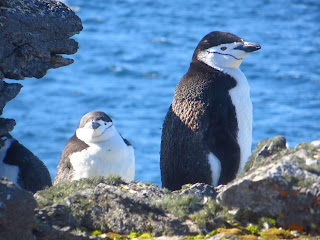
Our flight back to Chile was on a chinstrap penguin.

In English we call them "chinstrap" penguins. In Spanish, they are "barbijo" because a "barba" is a beard.

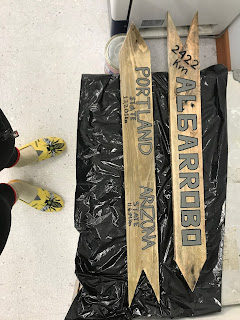
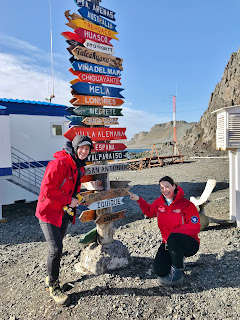
Before we left, we left our mark on Escudero! At the Navy station nextdoor, there is a sign post telling the distances to everyone's home towns. Dr. Hannah and I added our homes to the tower of signs!

We are 11,634 km from ASU and 13,201 km from PSU. Algarrobo is the home of our friend Ricardo who helped us make the signs.


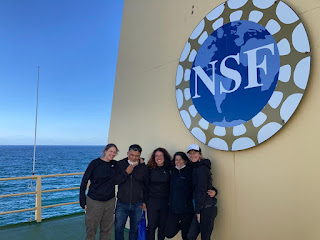
We are now back in Punta Arenas, Chile. We have spent the past two days packing our cargo and samples to ship home. We do that by working in the US Antarctic Program's warehouse in Punta Arenas. Here we are on the US research ship where we did a lot of our sample packing:

Dr. Becky and Dr. Hannah on the ends, with our Chilean collaborators Luis, Catalina, and Angelica in between us. We had a great team this year!

Later today, we begin the flight back to the U.S. We will soon be home!

Friday, March 11, 2022

Research wrap-up

We spent our last week finishing our research projects. One of the final projects we've been working on is Dr. Angelica's climate warming experiment. 

We still don't know all of the impacts of a warming climate, especially in a place so sensitive as Antarctica. In the U.S., being just a few degrees warmer isn't so noticeable to most of us. But in Antarctica where temperatures are so close to freezing, a few degrees is the difference between frozen water and liquid water. That matters a lot for the plants and animals that live there! The Antarctica Peninsula has already warmed by a few degrees over the recent decades, and will likely continue warming with the rest of the planet. Dr. Angelica has been learning the consequences of those warmer temperatures for the soil and plant communities.

How can we try to predict what will happen to the soil and moss that live in Antarctica when it's a few degrees warmer than it is now? We use structures called "open top chambers".  These are little greenhouses that are placed over the ground. The tops are open, so that rain and snow can still come in, but the sides help warm the soil and air inside the chamber by a few degrees. Dr. Angelica has placed some of these chambers at a few different sites around King George Island. We were most recently working on ones on a bluff that overlooks the Drake Passage.

The open-top chambers at Juan Carlos Point.

Inside the chambers, the soil and air are a few degrees warmer. So the moss and soil inside the chambers are experiencing a future Antarctica where it is a few degrees warmer. By watching how the soil and moss changes, we can try to predict the effects of climate change. Dr. Angelica studies how the plant community changes, and we will be looking at how the invertebrate community living inside the moss changes. We also measured photosynthesis and respiration inside the chambers. All of this will be compared to what's happening outside the chambers in "normal" Antarctica.

A peek inside an open-top chamber at Collins Outcrop, one of the other locations for the experiment.

So we've been working hard to finish collecting all of our samples. It's been very busy! There is of course time to stop for a little fun here and there, though. I brought my ukulele with me, and took a break to serenade the glacier. (My fingers were VERY cold, so don't listen too carefully for the mistakes.) Young people out there might not recognize the song. It's the theme from a muppet show called Fraggle Rock. If you've never heard of it, maybe ask your parents. :)


Tuesday, March 8, 2022

Photosynthesis & respiration

We have been busy working on our research projects. We completed our transplant experiment, which we like to call our little garden. We have planted grass, two different species of moss, and a cyanobacteria. In the coming years, we will check their progress and measure how the soil beneath them is changing.

Recently, we have been busy measuring photosynthesis and respiration from plants and soil. This is how we can describe how “busy” they are. When plants photosynthesize, they take up CO
2 from the atmosphere and lock it away inside the plant. Respiration is the opposite process, where the carbon inside of organisms is released back to the atmosphere as CO2. (Even humans release CO2 when we respire. When we breathe, we take in oxygen and release CO2.) To measure how active our plants and soil are, we measure how much CO2 is taken up by photosynthesis and how much is released by respiration. This is how we can measure the amount of carbon moving into and out of the soil ecosystem. We want to know which plants photosynthesize the most. We also want to learn whether the microorganisms living in the soil respire more when they live under certain plants.

To do this, we use an infrared gas analyzer. That’s a fancy name for a machine that uses infrared light to measure the concentration of CO2. We place the chamber on top of the plants and soil to trap the atmosphere inside. If the plants are photosynthesizing, the CO2 in the chamber will start to decrease, because plants take up CO2. If we use a dark chamber like in the photo below, photosynthesis will stop. But if the plants and microbes are respiring, the CO2 inside the chamber will increase, because we all exhale CO2 when we breathe.

We have measured plant photosynthesis and soil respiration from all of our study plants in all of the stages of succession. So we have done a lot of hiking to all of our sites where we find the different stages of succession. We get very tired, but we have a lot of data now!