Sunday, February 3, 2008

Final Touches

I finally got a chance to drive a piston bully today! It's my first track vehicle driving experience. It was FUN!!

Well, this is Elizabeth's and my last full day on Antarctica! This continent is such an amazingly beautiful, unique place. There was no way I could include all of the great photographs that I've taken since I got here. Here is a random sample of some other interesting photos I've taken over the past two months. Enjoy!

Taylor Glacier, where it meets Lake Bonney in Taylor Valley:
The three postdocs discover the station sign, cleverly hidden behind a lot of buildings and not at all visible to the public:
Myself and Elizabeth in the field one sunny afternoon:
What happens when you let a helicopter pilot get a hold of your camera:
Standing at the base of Canada Glacier, looking straight up:

Myself and Elizabeth working on some soil samples in the lab:
A sample of the underwater life living below the Ross Sea Ice. These guys are currently living in the touch-tank in the aquarium in the lab:
On the left: What Elizabeth was doing in the field one afternoon on Lake Fryxell.
On the right: What Becky was doing while Elizabeth was working in the field that afternoon on Lake Fryxell.

It's late in the summer, and the sun is dipping lower onto the horizon. We're getting close to having a sunset! That signals that the end of the field season is near.

Weathering Antarctica

Antarctica is a very windy continent. In the Dry Valleys, with so much loose rock and soil, wind has a big impact on the landscape. Weathering is the process by which wind and the atmosphere break down rocks and minerals. There are many types of weathering, but on Antarctica mechanical weathering from wind is the most common. When the wind blows, it picks up pieces of rock and soil and carries them through the air, often at very high speeds. These pieces of small rock and soil blow past and around other rocks. The friction of the soil and rock particles in the air rubs away at the rocks being hit by the small pieces. This is called abrasion. It causes the rocks here to take on very neat shapes!

The rocks that take on these cool, weathered shapes are called ventifacts. They have been worn down, grooved, and polished by the wind and the grit it carries. Ventifacts are very common in dry, desert environments. We see lots of ventifacts of all shapes and sizes in the Dry Valleys. Here is a particularly cool one that we found around Lake Bonney last week that Elizabeth is using as her throne!
The soil, sand, and rock that are blown around by the wind don't always remain on land. Sometimes soil is blown onto nearby sea or lake ice, creating what is called "dirty ice." The soil absorbs and holds more warmth than ice, causing the ice beneath the soil to melt faster than neighboring uncovered ice. There is a large patch of dirty ice near the entrance to Garwood and Marshall Valleys. We have flown over it several times now!
Our time on the Ice is coming towards a close soon! We fly away from McMurdo on Tuesday. That means we have one more full day on station to get the rest of our work done and soak up the Antarctic scenery. We have a lot to do!

Saturday, February 2, 2008

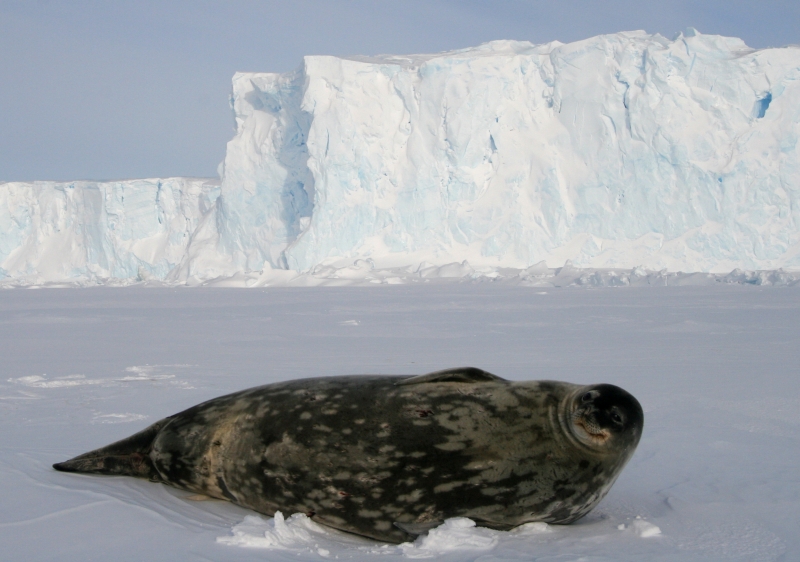
Weddell Seal

One Antarctic animal that I haven't talked about yet is the Weddell Seal. Seals are marine mammals that breath air and live on land, but spend much of their time in the water. The Weddell Seal is a species that lives in and near Antarctica. They live farther south than any other mammal!
[photo credit: Wikimedia]
Because Weddell Seals live in such a cold environment, they have a very thick blubber layer to help keep them warm. They are a bit fatter than most other species of seal, and can weigh up to 1000 pounds! They also have dark fur to help absorb sunlight. Lying on the sea ice in the sun also allows seals to warm themselves. Throughout the day, there are hundreds of Weddell Seals lying around on the ice while we're out working hard in the field!
Weddell Seals hunt in the water for fish, squid, and krill (very similar to what penguins eat!). Seals are very well adapted for swimming in the water to hunt. They can dive very deep (up to 700 meters) and hold their breath for over an hour (up to 80 minutes!). Myoglobin in the seal's blood stream helps store oxygen for longer periods of time, allowing them to dive so deep and long. They are also able to collapse their lungs and lower their breathing rates.

Weddell Seals also mate underwater. They give birth to pups in the Antarctic spring, during September to November. Pups reach maturity after 3 years.

However, the water is not always safe for seals. Their main predator in this area are orcas (killer whales), which love to eat seals! When they're not hunting, seals stay on the sea ice, where it's much safer. However, they still have to be careful, because an orca will come by and jump onto the end of a loose piece of sea ice to knock a seal into the water!
Seals aren't as social as penguins. While you'll find penguins in large groups, seals tend to spread out. They scatter across the ice as individuals, rather than hanging out in large groups.

Weddell Seals can live for up to 20 years, which is actually much younger than most other species of seals, which can live for up to 40 years. The reason Weddell seals don't live as long as other seals is that they constantly have to chew away at the ice to give themselves breathing holes, which means their teeth wear out much earlier in life. Without good teeth, they can't eat which means they won't live as long. Sometimes, seals crawl far into the Dry Valleys. Because they are so far from food and the ocean, they die there. Because it's so cold, the bodies don't decay very quickly, and we occasionally find centuries-old mummified seal carcasses while we're doing our field work! I'll spare you the photographs...

Weddell Seals are not the only seals living in Antarctica. There are also leopard seals and elephant seals, but they do not live in this particular area of Antarctica where we work. Elephant seals are much bigger and hunt larger animals, and have even been known to attack humans! The skulls below show you the difference in how the animals are built. The elephant seal on the far right has a bigger hard with much sharper teeth (and a stuffed animal in its mouth) than the Weddell seal skulls on the left. I'm glad I haven't met an elephant seal!

Friday, February 1, 2008

Well, Elizabeth and I have had a very exciting past few days! A lot has been going on, both with field work and around McMurdo.

We've taken several trips to new places in the field!

Earlier in the week, we traveled to Lake Hoare. This lake is also in the Taylor Valley, between Lake Fryxell and Lake Bonney, where we've been spending most of our time. We wanted to see if any cool moss forests were growing around Lake Hoare. Elizabeth was very happy, because she found some! We also measured soil respiration for the full 24 hours that we were there. This way, we know exactly how active the critters living in the soil are at different periods of the day. Staying at Lake Hoare also means that we get to hang out out with the camp manager, Rae. She lives at Lake Hoare all season to make sure that everything runs smoothly in the Valley for the scientists. She also is a great cook and very good at Boggle!

I also traveled around to upgrade all of our "met" stations. These are electronic equipment that live in certain locations all year to measure soil properties at regular time intervals. The little boxes have probes that go into the soil to measure moisture and temperature, which are useful pieces of information when we interpret the data we collect each field season. This type of information is called "metadata" (hence the name "met" stations). Once a year, we go around to these stations to download the data they've recorded all year, and replace the batteries. This is what I like to call the "Metstravaganza!" I serviced these stations with my friend Hassan at many places I've already been, but also at one new location: Beacon Valley. Beacon Valley is farther inland than Taylor Valley, and looks quite different. The soils are very red and volcanic, and there are no streams or lakes running through it. It felt like I was landing on Mars! Since it's farther inland, it's also colder. It was very sunny, but still -10 degrees Celsius.

Today, we went to Marshall Valley, which is farther southwest of where we usually work. We were looking for mosses, since we didn't know if any grew there. We walked for hours without finding any, but we found a small patch just before the helo came to pick us up and take us home! But, it was a beautiful walk, even if we didn't find many mosses. It had just snowed there, so the valley was covered with a beautiful dusting of snow.
We've been flying a lot this week for our various day trips. We've flown a lot with a great pilot named Dustin, who has been explaining to us everything we want to know about the physics of flying a helicopter and how to navigate. We were given this website to help practice our flight skills. You can practice, too!

In town, there's also a lot of excitement. The various big ships are starting to arrive to bring supplies and fuel to McMurdo. The coolest ship is the Gianella, which is the supply ship that brings all of the fuel McMurdo will need for the next year. The Gianella has the coolest two Captains, Bob and Rob, who took us on a tour of their boat. We got to see the 5-story engine room that gives the Gianella her 15,000 horse power. We also walked the 608-foot deck. Here's a picture of Elizabeth and I at the stern, looking out over the Ross Sea (taken by Capt. Rob himself!):
There was also a research vessel in town: the Nathaniel B. Palmer (nicknamed Natty P). This is a boat that travels to Antarctica each year, so that marine biologists aboard can conduct scientific studies along the way. The boat has a lot of equipment that monitors all sorts of water properties, which the scientists can read from the TV's in their bedrooms. Here's a picture of Elizabeth sitting proudly in the captain's chair on the bridge of the Palmer:
We also toured the Waste Water Treatment Plant at McMurdo (because we were curious!). We got to see how all of the water produced by people living at McMurdo is treated. All sewage comes into this building, where microbes consume the waste material to eliminate the carbon and nitrogen. They purify the water as much as possible. The purified water is then separated from any remaining "sludge". The clean water is pumped back into the Ross Sea, while the sludge is collected, compressed, boxed up and shipped back to the US for disposal. I don't have any pictures of the waste water plant, but it was certainly interesting!

Elizabeth and I are coming to the end of our stay in Antarctica. Today's trip to Marshall was our last flight out to the Dry Valleys. The next several days will be spent cleaning up the lab, packing up our samples to send back to Dartmouth, returning our gear (and probably playing a little bit with the helicopter simulator...).

Wednesday, January 30, 2008

McMurdo Culture

There are more than just scientists living at McMurdo Station. In addition to the scientists, there is a large population of people that support staff that keep the base running. That includes the people that feed us, clean up after us, maintain the buildings, fly the helicopters, run the laboratories, and keep everyone on schedule. And so much more! During the busiest part of the season, there are up to 1,200 people living in McMurdo! With that many people, there is definitely a culture to the town, with all sorts of entertainment available.

There are several special events that happen each summer. One of them is an outdoor concert called "Ice Stock." Each year, make-shift bands get together and practice just for this event! These are people that are generally not normally musicians by trade. So, the bands are very interesting!
Another annual event is called MAAG (the MEC Alternative Art Gallery). This is run by one of the departments (the MEC). They turn their building into an art gallery where artists in town can display their art. This is usually the home of very strange art, not normal types of art like paintings and drawings. The art is usually made out of spare items that can be found around McMurdo, such as Bacon Santa (made by someone that works in the Galley) and huge sculptures made from construction materials.

There are also several fun places in McMurdo that are regularly open. One of them is the bowling alley. At McMurdo, we have the only remaining manual bowling alley! Somebody stands at the back of the lane to return balls and replace the pins into their standing positions for the bowlers out at the other end of the hall.
There is also a small weight room for exercise, a coffee house, a fast food burger joint (Burger Bar), and various craft rooms and classes. We're, of course, surrounded by beautiful nature, and you can hike, run, or ski along several trails near town.
So, in McMurdo, there's never really time to get bored!

Sunday, January 27, 2008

Best Camp Hair Winner

Well, the votes are in, friends! I can now announce the first annual, internationally acclaimed owner of the Best Camp Hair! The people have spoken, and their choice is:

Elizabeth Traver!

Here is ET's victory shot, taken on day 5 in the field last week at Lake Fryxell. Please notice her elegant form, superior height, and blatant disregard for gravity.

My thanks go out to those who voted! Some highlights of comments made during the voting:

"[All] achieve great heights, both literally and stylistically."

"
That is some quality natural hair product he’s got going on there."

"...But nobody has a good Edward Scissorhands 'do."

"The curly head looked too much like my hair on a good day."

-~~~~~~~~~~~~~~~~~~~~~~~~~-

Today, Elizabeth and I are supposed to go back to the field for two days. We'll be staying at Lake Hoare, one of the lake basins in Taylor Valley that we've not yet visited. But, it's currently windy and snowing, so we're still sitting in McMurdo on weather hold. Hopefully we'll get back out today...

Saturday, January 26, 2008

Heroic Age of Exploration

Today is the 167th anniversary of the first sighting of Mount Erebus.

Mt. Erebus is the volcano located on Ross Island (where McMurdo is located). It is the southermost active volcano in the world! It was named after the Erebus, one of the ships sailed by early explorers to Antarctica, who first saw the volcano on January 27, 1841.
During the 1800's, polar exploration was in full tilt. Many of the places and features on Antarctica are named after early explorers or their ships. For example, McMurdo is named after Lt. McMurdo, who sailed under James Ross on the Erebus and Terror when this area of Antarctica (now called Ross Island) was discovered. This period of time is referred to as the Heroic Age of Exploration. It was a time when polar exploration was just beginning to grow popular, and many men and ships set out to learn about both the Arctic and Antarctic. They were often in search of new shipping routes and mapping that would make their country more money, as well as in the search of more knowledge about science and geography.[Photo credit: Wikipedia]

Polar exploration was, in many ways, very similar in the 1800's as it is today. Both these early explorers and modern scientists travel on military vessels to reach Antarctica. The early explorers traveled from northern Europe on Naval ships. England, especially, had greatly built up its Navy to defeat other European countries in wars at sea. By the mid-1800's, when England had won the battles, the Navy was huge and powerful with nothing to do. So most early explorers traveled to the Arctic and Antarctic on military vessels, manned by the Navy. Today, we still travel to Antarctica with the military. The US Air Force flies us from New Zealand to McMurdo, and our supplies are brought by the Navy. This year, the Naval battallion bringing our supplies are from Williamsburg, VA near my hometown!

Luckily for us, travel has become faster and much safer. Scientists are able to come down for short periods of time, lasting just a month to a year or more. In the 1800's, sailors signed on to polar expeditions that were several years long, and they were never exactly sure when they'd return. Today, we also have GPS's, radar, and satellite, and we know how to avoid bad weather! During early polar expeditions, sailors would sometimes become shipwrecked, and be marooned in the Arctic for years! Sometimes the ships would get stuck when the sea froze in winter, and have to live on the ship for a year before it melted again the following summer, allowing them to continue their journey.

Staying warm has also changed a great deal. Today we wear synthetic materials designed by engineers. In this picture at Canada Glacier, I'm wearing "bunny boots" (clunky white boots with extra air pockets to keep my feet warm), fleece long underwear, Goretex wind pants, goose down parka with fur-lined hood, fleece neck gaitor, and UV-protective sunglasses.Early explorers did not have this technology. They wore a lot of heavy animal skins, worn loosely to prevent sweating. Frostbite was much more of a problem with early exploration than it is now![photo credit: solarnavigator]
Early explorers built wooden huts for shelter and to house supplies. Huts were built at various points around Antarctica in preparation for an expedition that would travel between the huts. These huts still stand today, since there are not many microbes here that are able to decompose the wood. This is one of Scott's huts that still stands near McMurdo Station:Today, we have permanent, modern facilities with electricity, internet, heat, and even plumbing in the ones at McMurdo.

Working on Antarctica has definitely become much easier. Now, we have trucks, helicopters, and piston bullies to move us around Antarctica. In the early days of exploration, gear was carried on land by sledge. Sometimes these sleds were pulled by dogs or ponies, but often animals were not available and sledges were pulled by the explorers themselves. This is called man-hauling. Sledges were loaded with supplies from the ship, at a ratio of 260 pounds per man hauling the sledge. Can you imagine pulling sleds that weigh almost a ton through deep snow through howling winds in the winter when there's no sunlight and temperatures hover around -40 degrees?! It was slow and hard work, and particularly frustrating on ice sheets. If a crew of men hauled a sled forward 11 miles in a day, they could still end up having gone backwards 35 miles because the ice sheet was floating away from the destination.[Photo credit: Classroom Antarctica]

Unfortunately, many of the early explorers did not learn much from the native peoples they met in the Arctic. They made a lot of foolish mistakes that lead to a lot of deaths. For example, they often would refuse to eat the fresh meat available in polar regions (e.g. seals) that Inuit people would eat. Instead, they ate canned meat from Europe. Canned meat was, at that time, newly invented, and production was not very good. Canned meat contained very little nutrients (it had been boiled out of the meat) and were tainted with lead and botulism. They also considered the Inuit people lazy, as they did not move quickly. However, the Inuits knew that if they moved fast enough to break into a sweat, the dampness would cause them to become cold and possibly hypothermic. Many early explorers considered the Inuit lifestyle barbaric, and would not learn from how the Inuit people had learned to survive. The explorers that were most successful were those used to cold climates (such as Amundsen from Norway) and willing to adapt to Inuit styles of clothing and eating.

Many explorers were foolish, and did not make arrangements for rescue, should something go wrong. After discovering Ross Island and Mt. Erebus with James Ross, the two ships Erebus and Terror were sailed to the Arctic under John Franklin in search of the Northwest Passage. They traveled with almost 200 men on board, only two of which had any experience in polar exploration. The ships were wrecked, forcing the men to abandon the ships and travel on land. The crew had to man-haul the supplies across land. Rather than bringing only the necessities, they attempted to bring EVERYTHING from the ship, including the fine china and pottery, which was absolutely useless when trying to survive. There were too many men to be helped by the Inuits, because there is not enough food to feed 200 people at one time. Since no one in England knew where they were, the many ships that went to rescue them could not find them. The men all died after years of suffering in the Arctic. No lessons were learned, and the same foolishness occurred in when Sir Robert Falcon Scott attempted to reach the South Pole on Antarctica. They still had not learned, even from the great experiences of previous sailors, how to properly work in extreme cold. All men in Scott's party died on the way back to their ship from the South Pole.

Though many mistakes were made, there were a great number of wonderful discoveries made through Antarctic exploration. Early explorers were greeted by the same beautiful sights that greet modern Scientists: monstrous glaciers, volcanoes, huge rugged mountains and valleys, and unimaginably large expanses of ice.
Click here to learn more about Antarctic Exploration on Cool Antarctica.