Thursday, February 10, 2022

Hurry up and Wait

Our flight this morning was a no-go. This is how it goes with Antarctic research. It is a windy continent, and with no help nearby, you don't want to take risks. We often get rushed from one place to another just to sit around and wait. We woke up at 5:30 am and went to the airport, but we had to turn around and come back to the hotel because the flight to Antarctica was canceled. They are predicting it will be Saturday when we can try next. At least we got a brief moment out of the hotel room and finally met some of the other scientists heading to Escudero with us!

So, now we are back in quarantine! It's been 9 days now. We do our best to stay busy. It helps if we get up and move a bit, even though there's not a lot of space in the hotel rooms. Dr. Hannah and I are using  Richard Simmons workout videos on the internet to stay moving. We like the fashion from the 1980s episodes. (Don't know who Richard Simmons is? Ask your parents!)

Dr. Angélica prefers this one:


We also like to spy on the boats on the Strait of Magellan outside our window. There are fishing boats, cruise ships, cargo ships, tug boats, and all sorts of boats to watch. Do you want to see the boats we're watching? You can spy on them, too! MarineTraffic 

Wednesday, February 9, 2022

Ready... set...

We have spent another full day in quarantine, because the weather would not allow us to fly to Antarctica. But, there was a ray of hope at the end of the day!

A rainbow over the Strait of Magellan

We learned during dinner that we will attempt a flight tomorrow morning! We have to gather together at 6 am for our flight. Hopefully the weather cooperates and we are able to finally head to Escudero!

Tuesday, February 8, 2022

Nature disagrees

Well... we were all geared up to leave for Antarctica today, but nature did not cooperate. 

Dr. Hannah ready to brave the weather in her INACH gear!

As you can see in this image from the Chilean Navy, there is some bad weather over the Drake Passage between us and Antarctica! The light blue colors are light cloud cover or rain, and red is thick clouds and heavy rain.

Cloud top infrared imagery from the Chilean Navy Weather Service.

That is because there is an atmospheric river overhead. An "atmospheric river" is a stream of concentrated water vapor in the atmosphere. They can be thousands of miles long (but only a couple hundred miles wide), which is why they look like rivers in the sky. Plus, they can carry more water than rivers on land! But, the water is there as a gas (vapor), not liquid water. But when that water vapor cools (like after making landfall) and turns into a liquid, the moisture becomes rain. So there is wind and rain that have messed up our flight plans!


You can see the tail of the atmospheric river passing over Punta Arenas and down towards the Antarctic Peninsula in this satellite image from last night:
University of Wisconsin's Space Science & Engineering Center

Since we can't fly, we have an extra day of quarantine. We haven't left our rooms for a week, now. We have been able to get some work done. We have meetings to discuss our project over the phone. (We are living within arms' reach of each other, but we are in separate rooms so can't see each other in person!)

Dr. Becky, Dr. Angelica, and Dr. Hannah discussing very important science!

So, we have one more night in our quarantine hotel. Or maybe more! We get an update tonight. 

Monday, February 7, 2022

INACH

We are in our last day of quarantine! Tomorrow we leave Punta Arenas, Chile and fly to Escudero Base to begin our field work!

Base Escudero is run by the Chilean Antarctic Institute. In Spanish, that is the Instituto Antártico Chileno, or INACH. Chileans have a close connection with Antarctica, because they are not very far apart. The distance between Punta Arenas and Escudero is about the same distance between Phoenix, AZ and Dallas, TX, or the distance between Phoenix and Yellowstone National Park. 

INACH scientists have done a lot of great research over the decades. I am excited to be working with them this year at their research base, and proud to be officially outfitted in my INACH gear!

Do you see my little friend in my coat? He is my research partner this season.

The water in between Chile and Antarctica is the Drake Passage, which is well known for having rough seas! (That is what makes the Strait of Magellan so important. It is a safer way for ships to cross from the Atlantic to the Pacific Ocean!) Luckily, we get to fly over the Drake Passage, instead of being tossed around on a ship. Our return trip in March will be on a ship, though, so we will be tossed around later.

My week in quarantine was turned into an extra adventure because the airline lost my luggage on the way here. All of my clothing and research gear were missing! All I had for my week in quarantine was one extra set of clothes and a small emergency bag of toiletries. Since I was not allowed to leave the hotel, I couldn't go shopping to replace anything! For the past 6 days, I spent every evening washing my clothes in the bathroom so they would dry for the following day. The staff from INACH were very kind, and went shopping for me so that I could have toothpaste and clean underwear. 

After a few days, we worried that my bag might never arrive. The staff from INACH and the U.S. Antarctic Program helped me gather the supplies I would need for Antarctica. They packed warm clothes for me to wear and some extra research equipment. You can see here some of the things that they brought me to stay warm and dry: long johns, fleece pants and coats, hats, boots, water-proof gloves, ski pants, and a big coat.

It was very stressful to lose my luggage, but luckily I have a lot of good friends here in Punta Arenas that helped! My luggage FINALLY arrived in Punta Arenas last night at 10 pm. That was just in the nick of time, because this morning, Pablo from INACH came to pick up all of our luggage so that it can be loaded onto the plane for our flight tomorrow. Then, our science will begin!


Friday, February 4, 2022

Quarantine life

We have been in Punta Arenas for a few days. We are in quarantine until we go to Antarctica. Everyone is being very careful to make sure COVID does not come to the research station, so all of us traveling on this flight are in a quarantine hotel for 7 days. We checked in on February 1, and we will not be able to leave our hotel rooms until it's time to go to the airport to board the flight to Antarctica on February 8.

If we leave our rooms, we might be exposed to COVID without knowing it. Nobody from outside the hotel can come in to see us because they might expose us to COVID. Hotel employees can come to our door, but not into our rooms. They bring us food and other items that have been sterilized, but we cannot receive any deliveries from outside the hotel.

The hotel staff are taking very good care of us! All of our meals are delivered to our room. The food is very good! Breakfast is delivered around 8-9 am. We get a sandwich (sometimes egg salad, jam and butter, or meat and cheese), yoghurt, a piece of fresh fruit (an apple, orange, or plum), a cereal bar, and a juice box. Plus I can have a cup off coffee! It's a lot of food, but it's nice to be able to eat part of it and snack on the rest throughout the morning. 

Lunch and dinner are both hot meals, and they have been delicious! I have had steak and potatoes, chicken curry, fish, and speghetti. They even come with a little bit of dessert. So we are eating very well, despite not being able to leave our rooms.


Meals here are a bit later than we are used to in the U.S. Lunch comes around 1-2 pm, and dinner around 7-8 pm. But that's ok, because around 5 pm we have "once"!

Once is the Spanish word for "eleven". (So, it's pronounced "on-say".) Around 5 pm, we have a cup of tea or coffee with a little sweet treat. It is similar to having "tea time" in other countries. In those places, it is usually a mid-morning break around 11 am, so it is called "elevenses". But in Chile, it shifted to being in the afternoon between lunch and dinner. It just kept the name of "elevenses" (or once, in Spanish), even though it's at 5 pm.

The only other time I open my door is when a hotel clerk comes by each day to trade my dirty towels for clean ones, and drop off anything else I might need (like toilet paper or soap). So, I spend a lot of time alone in my room, but it's ok. I have a corner room with two windows, so I can watch the ships on the Strait of Magellan and people moving around the beautiful, old bank building next door. There is always something interesting to see! 

Dr. Hannah took this picture from her window at sunrise this morning.

The windows open, so I can feel some fresh air. I have a comfortable bed and plenty of work to do on my computer while I wait to go to Antarctica. Hopefully we did not accidentally pick up COVID in the airports to get here. I would like my next test to also be negative so that we can go next week!


Wednesday, February 2, 2022

Punta Arenas

We have arrived in Punta Arenas! We left Santiago very early in the morning, and landed in Punta Arenas just in time for a late breakfast.


Chile is a long, skinny country. It is 2,700 miles long, which is about the same distance as the width of the U.S., from the west to east coast. A lot can change over that distance, so there are a lot of different ecosystems in Chile. (Think about how many different ecosystems are in the US across that distance!) In the northern part of the country that we flew over to land in Santiago, there is the Atacama Desert. The area looks very familiar to those of us who live in Arizona. But, the Atacama Desert is actually much drier than the Sonoran Desert where we live. In Phoenix, we get about 8 inches of rain per year. The Atacama receives less than one inch per year on average. The wettest places receive 1-3 inches per year, but some places have no record of rainfall at all!

Punta Arenas is at the very southern tip of Chile. It is at the southern end of Patagonia, which is a steppe ecosystem in the southern end of South America. It is a cold, rainy, and windy city! While we were in Santiago, it was sunny and 85°F. Here in Punta Arenas, it's only around 50°F, and it drizzles much of the day. It is also very windy. Even though it's summer, most people are bundled up in winter coats and hats.

Punta Arenas is on the Strait of Magellan. A strait is a narrow band of water that connects two larger seas or oceans. The Strait of Magellan cuts through the southern tip of South America to connect the Atlantic and Pacific Oceans. A lot of cargo ships and cruise ships use the Strait of Magellan to cross between the oceans, and Punta Arenas is also a popular port for heading to Antarctica. So there are a lot of ships in the area. We had time for a quick walk on the shore before we had to check into the hotel for our week of quarantine.


The orange ship  you see in the distance is one of the research vessels that the U.S. Antarctic Program owns. The last time I was in Punta Arenas, it was to board this ship and head to Antarctica. This year, though, we are with the Chilean Antarctic Program, and we will be flying in an airplane to our research base. It will be a much faster trip!

Monday, January 31, 2022

We are on our way!

We have started our journey to Escudero Base in Antarctica! The journey will take us over a week. First, we have to travel to Chile. Here is our route for this first part of the trip:

My other team member from the U.S. is Dr. Hannah from Portland State University. On Saturday morning, we left our homes and met each other in the airport in Houston, TX. After a VERY late night, we then flew from Houston to Santiago, Chile. 

Travel to other countries is hard now, because of COVID-19. We had to be tested for COVID before we left the U.S., and we were tested again yesterday when we arrived in Santiago. We spent three hours in the Santiago airport having our medical papers checked, our passports inspected, and getting tested. All of this was just to be allowed out of the airport and into Chile!

Dr. Becky & Dr. Hannah in line to get our COVID tests in the Santiago airport

We are currently in a quarantine hotel in Santiago where we waited for the COVID test results. Both of our tests were negative, so now we can complete the next part of our journey. Early tomorrow morning we will fly to Punta Arenas at the very southern tip of Chile.

We have to quarantine in Punta Arenas for seven days before we can go to Antarctica. We definitely don't want COVID to spread to the research base in Antarctica, where there are no hospitals. It is possible that we were exposed to COVID during our travel through the airports. We can't go to Antarctica until we know we didn't catch it. If we make it through the seven days without showing signs of COVID, we will be able to go to Antarctica. There is just one flight that is able to take us to Antarctica on February 8. If we do catch COVID, we will not be allowed on the flight and will have to return home. We have tried to be very careful, so hopefully we do not get sick. Otherwise, we will not be able to try again until next year. (That will make for a very short blog this year, wont it?)

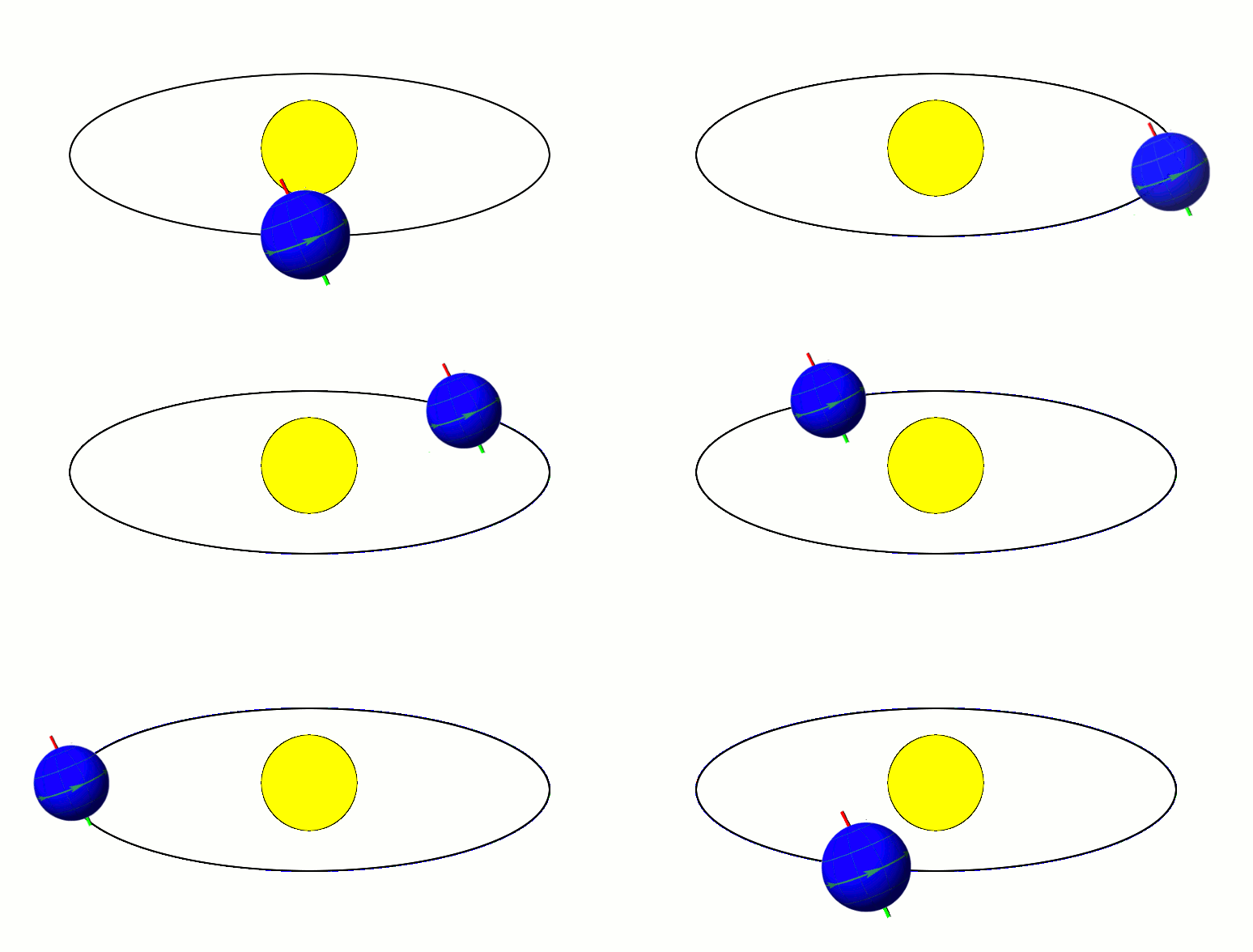
For now, we have negative tests so we were allowed to go outside for a walk. Because Chile is in the southern hemisphere, it is late summer, even though it's late winter in the U.S. The seasons are opposite because the Earth is tilted. Right now, the southern hemisphere is closer to the sun, and the northern hemisphere is tilted away from the sun. That means the southern hemisphere has more incoming energy from the sun, so it is warmer.

Image source: https://gifer.com

So, we were able to enjoy some warm, sunny weather for our walk outside. Phoenix is still fairly warm during the winter, but for Dr. Hannah it was a big change, because Portland, Oregon is farther north and much colder during winter!

As the Earth moves around the sun, it will switch and the northern hemisphere will be closer to the sun. When it is summer in the U.S., it will be winter in Chile. 
Image source: Wikimedia

Antarctica is in the southern hemisphere, too. The plants and animals are only active during the summer when temperatures can be above freezing, which is why we are going now (assuming we haven't caught COVID!).